

Ikigai Spotlight Series: Saya Fujihara, Founder of Sekirara Card

On a life of being honest and true to yourself
Ikigai is a concept that is very much integral to Japanese culture. The word 'Ikigai' can be roughly translated to your 'reason for being', or purpose and is not confined to the ‘Venn Diagram’. More on its authentic definition can be explored here.
While Ikigai is essential to one's well-being, the true beauty is that it does not have a fixed equation and can change over time.
At Mogami, we would like to highlight this nuance with our 'Ikigai Spotlight Series'.
This month’s featured guest is Saya Fujihara, the founder of Sekirara Card. Drawing on her own experiences and challenges in relationships, she created a communication card game that encourages honest conversations between partners and loved ones. Her hope is for more people to care for their relationships and mental health as they do for their physical health.

To begin, could you please introduce yourself?
My name is Saya Fujihara, and I’m the creator of Sekirara Card. The core product at Sekirara Card is a conversation card game made up of 50 simple cards, each with one question written on it. The intention is to play with your partner if you’re in a couple. There are cards such as: “When was a recent moment you felt loved by your partner?” — questions that might feel embarrassing to say out loud, but would make you happy to say or to hear the answer. There are also cards such as “What is your personal definition of cheating?” or “Share something your partner has done that you didn’t like”. Topics you might want to talk about, but find difficult to put into words.
Even when you know it would be better to talk things through, it’s often hard to open up yourself. Sekirara Card is designed to incorporate that delicate balance and act as a tool to gently allow you to start those conversations.
The reason I created them is because I personally had difficulties with relationships. In the past, even when I had doubts or anxieties about my partner, I was too afraid of being abandoned to say anything. For example, even if I felt deeply hurt, or noticed something like the way they spoke to service staff, I often stayed silent. There were many relationships where I couldn’t express my true thoughts. Friends would tell me, “You should talk about it.” And I knew they were right but actually taking that step was incredibly difficult.
After talking to others, I realised I wasn’t alone. There’s an abundance of media about love and relationships, but even if people know what they should do, actually committing to action is the hardest part. To lower that barrier, I focused on something familiar and accessible — a card game that could lead naturally into conversation.
When I tried the cards with my own partner, I felt a real joy in being able to talk about things I’d never been able to say before. I realised that talking didn’t lead to separation or hurt —
instead, it became time for the two of us, thinking about each other, for each other. It felt like our partnership and bond deepened. I realised that this sense of safety is something we can create for ourselves. I wanted more people to experience that feeling, which is why I founded Sekirara Card.


What has been your personal journey with your Ikigai(s)?
Living honestly with myself is something I’ve always valued, ever since I was young. After graduating high school, I was determined to become a dancer, and I lived my life with that single goal in mind. I went to university in the U.S. to pursue dance, but also studied liberal arts and became increasingly interested in gender studies.
I’ve never really changed my opinions because of what others said. Both dancing and moving to the U.S. were decisions I made despite opposition from my parents and people around me. Even though I went to the U.S. for dance, I noticed “what feels right for me now” changed, and I found myself drawn to a different path. When COVID happened, I returned to Japan — not because I was forced to, but because I felt that my life in the U.S. had come to an end.
Looking back, I wouldn’t say there’s a lot of consistency in what I’ve done. But what I’ve always prioritised is trusting my own thoughts and instincts, and choosing my own path. For me, not doing that would be far more painful. From a young age, I experienced the happiness of doing what I truly wanted, so living any other way feels like the real challenge.

How do your current lifestyle and work reflect your values and inner truth?
Honestly, I feel that my values are reflected in everything I do. In terms of work, I’m running a business built around what I value most, so “living honestly with myself” is really reflected there.
In my personal life as well, my husband and I have prioritised communication since the very beginning of our relationship, and it’s become a habit between us. For example, every Sunday evening at 7pm, we set aside time just for the two of us. We look back on the week and share: something our partner did that made us happy, and something we would like to ask of our partner. This time is incredibly precious to me.

As another everyday example, I rarely go out shopping, and only buy things when I truly feel convinced or compelled. Even if the typical or societal forms of happiness don’t resonate with me, I feel deeply fulfilled in other ways. I think being able to clearly separate my own values from those of mass media is one reason I’m able to live more authentically.
Was there a time in your life when you felt lost? What helped you during that period?
There was a period of about two years when I felt very lost, around the ages of 23 to 25, about five years ago, before starting Sekirara Card. I went to the U.S. intending to become a dancer, but gradually became interested in social fields such as media theory and gender studies, and started to drift away from dance. Gender issues in particular overlapped with my own relationship struggles. I realised I had internalised ideas like “women should be this way” and “men should be that way,” unconsciously creating gender gaps within myself.
As I was thinking about how to engage with these issues outside of dance, COVID hit. Los Angeles went into lockdown, and although it was supposed to be the job-hunting season, it was difficult to do anything, so I returned to Japan. Since high school, I had always believed I would live in the U.S., so I’d never imagined a life in Japan and had no information about how to live there. By the time my online classes ended, I was suddenly supposed to be a “working adult” in Japanese society. At the same time, I still held onto the dancer/ artist mindset of “I should do what I truly want,” and I couldn’t bring myself to sell my time to a company. I couldn’t find a workplace I wanted to give eight hours a day, five days a week to. I’m stubborn in a good way, but it made life difficult.
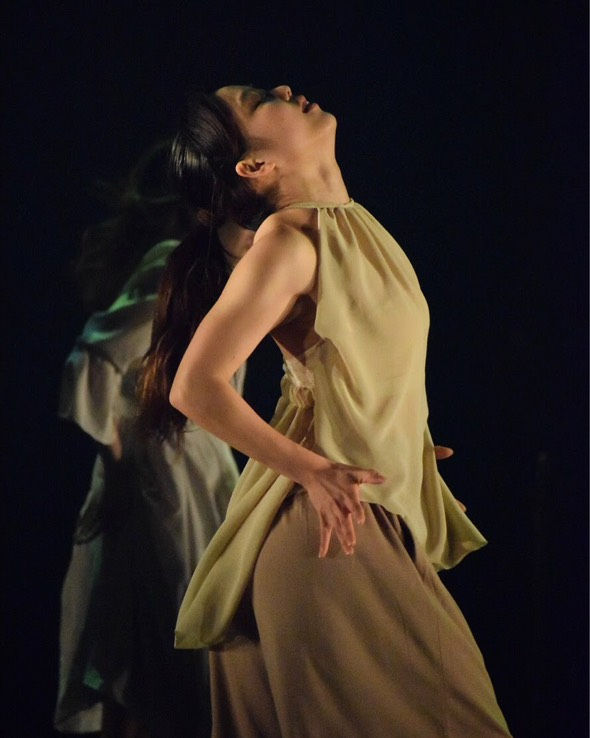
That’s when my period of uncertainty began. I didn’t know what I wanted to do, but I needed money, so I started with part-time work as an English teacher just to survive. I was barely getting by each month, and didn’t have the mental space to think about social or gender issues, or tend to the community-oriented mindset I’d developed in the U.S. At the time, I was living in Kamakura, and there was a phase where I got by on alcohol and cigarettes. In the evenings, I’d drink with neighbours who were in similar situations. It supported me in some ways, and strangely, it was also a fun time.
After about two years of what felt like rock bottom, I began to tire of that lifestyle, and my English teaching work gradually stabilised. As my life became more stable, I gained the mental space to think about others including my friends, my community, and gender issues again. That’s when I realised, “Gender issues are what I really want to work on.” That period at rock bottom was painful, but I don’t think I would have reached that realisation without it. From there, one thing led to another and ultimately to creating Sekirara Card’s products.
What does being an entrepreneur mean to you?
For me, becoming an entrepreneur feels like all of the dots have finally connected. I’m sure people sometimes wondered what I was doing as I moved from one thing to another, but looking back, everything was connected. It feels like a compilation of everything I’ve done so far.
As a student, I always pursued what I wanted to do. Later, my personal struggles and discomfort began to connect with broader social and political issues. Instead of holding all of that inside, I wanted to turn it into something tangible - a product - so others could also think through and process these issues, too.
There aren’t many precedents for this in Japan, and products like those at Sekirara Card are unlikely to become mainstream. From a purely economic perspective, it’s probably not something large corporations would choose. But that’s precisely why I believe there’s meaning in me doing it.
Beyond business numbers, I believe mindset, values, personal commitment, and emotional space are really important. Right now, I feel like I’m doing something only I can do. And whatever I do next, I’m sure the dots will connect again somehow, and that definitely excites me.

What does the word “Sekirara” mean to you?
For some people, the Japanese word sekirara* might feel embarrassing or intimidating. But for me, it means having the courage to be honest — truly for yourself. Ultimately, that honesty benefits not only you, but also the people you care about, and leads to joy.
It’s not just about feeling exposed. It always becomes something meaningful for you in the end. That’s why being brave enough to be honest is what sekirara truly means to me. It definitely does require courage.
Editor’s Note: *In Japanese, sekirara means to be naked, frank, or candid, describing something completely open, bare, or without concealment.
If you could give one piece of advice to your younger self, what would it be?
I’d tell my younger self, “You’re right not to worry so much about other people’s opinions.” I truly believe that now. (Laughs)

Finally, is there a message you’d like to share with readers?
Some people who read this interview or learn about Sekirara Card might think, “She could do it because she’s Saya.” I hear that a lot. But please set that thought aside for a moment. I was once someone who was so afraid of having difficult conversations — afraid of being hurt, and of hurting others. It wasn’t that I could already do this, or was strong to begin with.
What allowed me to act was imagining myself continuing to suppress my anxiety and doubt forever, and feeling genuinely sorry for that future version of myself. I believed that choosing honesty now, even if it meant tough conversations crying in front of my partner, would lead to a happier future. That courage didn’t come from wanting to be kind to someone else — it came from truly wishing for my own happiness.
Today, both in Japan and globally, we’re often told: “Exercise for your health,” “Be mindful of your diet.” That’s become normal. But why hasn’t the idea of improving our relationships for mental health spread in the same way? Honestly, it makes me angry.
Even in Japan, the number of gyms keeps increasing, and messages about diet and supplements flood the media. We know how important connecting with loved ones is for our well-being — and still, it doesn’t spread. Probably because it’s hard to monetise, results aren’t immediate, or it’s simply difficult. Talking honestly with a partner or friend can be far harder than going to the gym. But I want people to think of it the same way. Just as you go to the gym for your body, you can take that first step toward conversation for your mental health.
If this interview makes you pause and think, “Why don’t I care for my mental health the same way I care for my body?” — that would mean a lot to me. There is still so much we can do for our emotional wellbeing. It might be your relationship with yourself, or with a partner or family member. Sekirara Card’s conversation-starters are simply one tool, but I truly hope people will care for their relationships and their mental health. This is what I want to continue asking of society.

Emma's Reflection

Living honestly with herself doesn’t simply come naturally to Saya; rather, living any other way feels so unnatural that it becomes a greater challenge.
We can drift into situations or lives that don’t truly feel like our own — not necessarily because we don’t know what we want, but because it takes courage to pull ourselves in the direction our heart truly desires. As Saya shares, taking that step isn’t easy. Especially in relationships, being sekirara, candid, or open can feel deeply uncomfortable.
Yet on the other side of that honesty often lies something powerful: deeper connection to your authentic self, stronger partnership, and a true sense of joy. Thank you, Saya, for sharing this courage with us.
Do you want to learn more?
To learn more about Saya Fujihara and Sekirara Card:
Saya’s Instagram: https://www.instagram.com/saya_fujihara/
Instagram: https://www.instagram.com/sekiraracard/
Website: https://sekiraracard.com/
What did this story bring up for you? Comment below.


Comments